Nano Banana 2 Lite Release: A Full Breakdown
Google has released Nano Banana 2 Lite. Here is what shipped, how much it costs, where it fits in the Gemini image family, and what its limits mean.
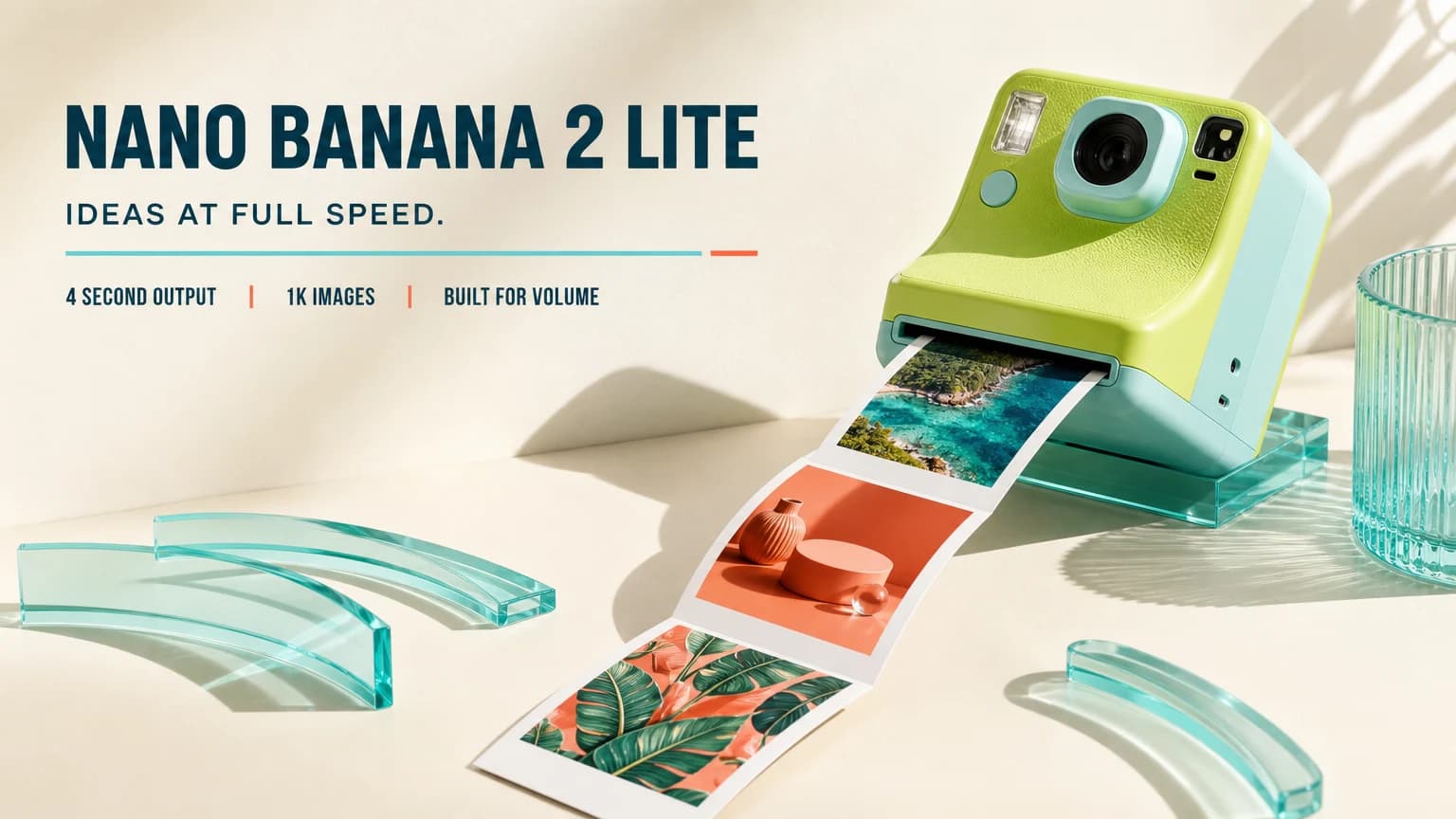
Google released Nano Banana 2 Lite on June 30, 2026. The model appears in the Gemini API as gemini-3.1-flash-lite-image, and the pitch is simple: 1K images in roughly four seconds, at a stated cost of about $0.034 each.
This is more than a cheaper endpoint. It gives Google a clearer three-tier image lineup and sets a new floor for high-volume creative work.
TL;DR
- Nano Banana 2 Lite is Google's fastest and most cost-efficient Gemini image model.
- Google states roughly four seconds for a 1K text-to-image output and a price of about $0.034 per image.
- The model sits below Nano Banana 2 and Nano Banana Pro in a new three-tier family.
- Google recommends Lite as the migration target for the original Nano Banana model, which is now treated as legacy.
- The trade-offs include a 1K output ceiling, weaker handling of small text and factual infographics, no Search grounding, and less reliable consistency across major scene changes.
What was released
Nano Banana 2 Lite became available on June 30 through Google AI Studio and the Gemini API. Google later confirmed general availability through its enterprise agent platform and described the model as built for fast, high-volume image pipelines.
Its API identifier is gemini-3.1-flash-lite-image. The model supports text-to-image generation, image editing, and conversational image workflows. Google documents support for up to 14 image inputs, common aspect ratios, 1K output, SynthID watermarking, and C2PA content credentials.
Google launched Gemini Omni Flash the same day. The pairing points at a longer workflow: Lite produces a reference frame in seconds, then a video model animates it.
Google's image family now has three tiers
The release reorganizes the Nano Banana lineup around three distinct jobs:
- Nano Banana 2 Lite: the speed and volume tier for near-real-time generation.
- Nano Banana 2: the generalist tier, balancing quality, speed, cost, and higher-resolution output.
- Nano Banana Pro: the high-fidelity tier for complex professional work and tighter control.
The original Nano Banana, based on gemini-2.5-flash-image, is now considered the legacy model. Google's recommended migration path is Nano Banana 2 Lite. That makes Lite the new baseline of the family rather than an optional budget variant.
Pricing
Google's launch materials list the headline cost at approximately $0.034 for one 1K image. The underlying API rate is listed as $0.25 per million input tokens and $1.50 per million output tokens under standard pricing.
That price matters most at scale. A team producing hundreds of drafts, catalog variations, or localized campaign assets can now run substantially more iterations before cost becomes the limiting factor.
FrameTide pricing is based on platform credits rather than Google's direct API invoice, so the amount charged inside the product may not map one-to-one to the raw provider rate.
Speed and low-thinking mode
Google states that Nano Banana 2 Lite can return a text-to-image result in about four seconds. Independent early coverage has reported Nano Banana 2 taking closer to twenty seconds on comparable prompts, although real latency will vary with region, queueing, prompt complexity, and provider overhead.
The four-second figure is associated with the default low-thinking behavior. Public documentation has not yet made clear whether developers can directly control that thinking budget or whether it remains an internal model setting.
What Nano Banana 2 Lite is good at
This is a throughput model, not a finishing model. It is strongest at:
- rapid concept development and creative exploration;
- advertising variations and A/B testing;
- product mockups and marketplace thumbnails;
- localized campaign assets produced at scale;
- reference frames for downstream image-to-video generation;
- applications that need image output to feel responsive.
Lite makes the most sense as one stage in a pipeline. Cheap reference frames lower the cost of exploring a direction before a team commits to a slower, higher-fidelity render or a video job.
Where it falls short
The Lite tier trades away capability in several places:
- output is capped at 1K;
- small text and fine spelling can be unreliable;
- factual infographics may contain incorrect details;
- character consistency can weaken when the scene changes substantially;
- complex multi-reference composition is not its strongest workflow;
- Google Search and Image Search grounding are not supported.
That rules Lite out as the default for large-format delivery, text-heavy advertising, data charts, or multi-frame stories that need strict visual continuity. Nano Banana 2 or Pro remains the safer choice there.
Availability
At launch, Google made Nano Banana 2 Lite available across Google AI Studio, the Gemini API, and its enterprise agent platform. Google also announced distribution across consumer and creative products, including the Gemini app, AI Mode in Search, NotebookLM, Google Photos, Stitch, Flow, and Google Ads.
The model is also available in FrameTide's Image workspace, where it can be selected alongside Nano Banana 2, Nano Banana Pro, GPT Image 2, and Seedream 4.5.
Nano Banana 2 Lite vs. Nano Banana 2
The gap between the two is deliberate:
- Latency: Lite targets roughly four seconds; early comparisons place Nano Banana 2 closer to twenty seconds on similar prompts.
- Price: Lite is the lower-cost tier, with Google's headline price at roughly half the sibling model's rate.
- Resolution: Lite outputs 1K; Nano Banana 2 can produce 2K and 4K images.
- Grounding: Lite has no Search grounding; Nano Banana 2 supports Google Search and Image Search grounding.
- Model ID: Lite uses
gemini-3.1-flash-lite-image; Nano Banana 2 usesgemini-3.1-flash-image.
Lite is the throughput model. Nano Banana 2 remains the general-purpose choice whenever resolution, grounding, or stronger consistency is worth the extra time and cost.
What is confirmed and what remains unclear
Confirmed at launch:
- the model is live in Google AI Studio and the Gemini API;
- Google states about four seconds per 1K image;
- the headline price is about $0.034 per 1K output;
- the original Nano Banana model is now treated as legacy;
- generated images include SynthID;
- known weaknesses include small text, infographic accuracy, and consistency across edits;
- Search grounding is not available in the Lite tier.
Still unclear:
- independent benchmark results against other major image models;
- production concurrency and enterprise rate limits;
- whether low-thinking mode will become a public API control;
- the measured prompt-adherence gap versus Nano Banana 2;
- regional performance and enterprise service-level commitments;
- how close the four-second claim remains under complex editing and many reference images.
Why the release matters
Nano Banana 2 Lite changes the economics of iteration. When a draft costs a few cents and arrives in seconds, teams can test more concepts, produce more variations, and abandon weak directions sooner.
It also clarifies Google's product strategy. Lite covers the wide top of the creative funnel, Nano Banana 2 covers general production, and Pro covers the work that needs the most control. Gemini Omni Flash then extends the same workflow into video.
For teams still using gemini-2.5-flash-image, the legacy label is another important signal. Google has not announced a shutdown date, but the migration direction is now explicit.
How teams should evaluate it
Launch claims are worth testing against real workloads. The most useful comparisons:
- Run the same prompt set through Lite and Nano Banana 2, then compare outputs without showing reviewers which model created them.
- Score small text, product labels, signage, and data graphics separately from general visual quality.
- Test how latency changes as reference-image count and edit complexity increase.
- Measure the full image-to-video pipeline rather than timing the image call alone.
- Check whether SynthID and C2PA provenance survive the downstream editing tools used by the team.
What to watch next
Three signals will decide how much this launch matters:
- independent quality benchmarks against GPT Image, FLUX, Ideogram, and other current image models;
- real latency measurements outside Google's own infrastructure;
- a formal deprecation timeline for the original Nano Banana API model.
For now the positioning is straightforward. Nano Banana 2 Lite is Google's new fast, inexpensive floor for image generation — built for work where getting to the next draft matters more than perfecting the last one.
Sources
Create with Nano Banana 2 Lite
Open the FrameTide Image workspace with Nano Banana 2 Lite already selected, and try it on your own prompts.